 EN
EN  TR
TR 
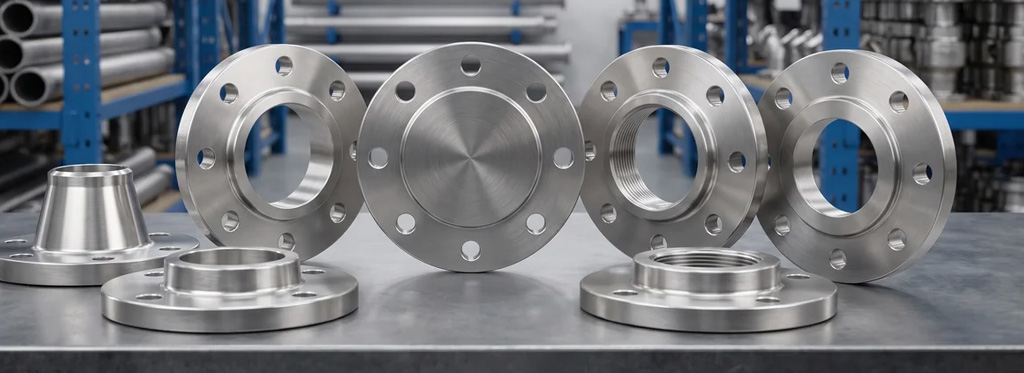
In industrial piping systems, connection safety, leak-tightness, and corrosion resistance are of great importance. Meeting these requirements is stainless steel flange types are used to connect pipes, valves, pumps, and other equipment together. Thanks to their bolted structures, they allow the system to be easily disassembled during maintenance, inspection, or component replacement operations.
The chromium content of stainless steel helps form a protective layer on the surface. The addition of nickel enables the development of durable and workable alloys that can be used in different environments. These properties make stainless steel flange products an important connection solution in water, chemical, food, energy, and petrochemical facilities.
Main Types of Stainless Steel Flanges
When selecting a flange, the connection method, system pressure, temperature, pipe diameter, and the transported fluid should be taken into consideration. The most commonly used stainless steel flange types in applications are as follows:
Weld Neck Flange
The weld neck flange is connected to the pipe by butt welding thanks to its long and tapered neck design. Since it helps distribute stress evenly across the connection area, it is preferred in high-pressure, high-temperature, and vibration-intensive systems. Power plants, refineries, and petrochemical facilities are among its common application areas.
Slip On Flange
The slip on flange is installed by inserting the pipe through the flange and welding it from both the inside and outside. It provides ease of alignment and installation, offering an economical solution for low and medium-pressure pipelines. It is widely used in water systems and general industrial applications.
Blind Flange
The blind flange, which has no flow opening at its center, is used to completely close the pipeline. It provides safe isolation in operations such as line termination, maintenance, pressure testing, and closing unused equipment connections.
Socket Weld Flange
The stainless steel socket weld flange is installed by inserting the pipe into the socket inside the flange and welding it in place. It is generally preferred for small-diameter and high-pressure systems. Thanks to its compact connection design, it can provide advantages in limited working spaces.
Threaded Flange
Threaded flanges are installed onto pipes using threaded connections without welding. They can be used in areas where welding is not suitable or where the system needs to be frequently disassembled. However, application conditions should be carefully evaluated in pipelines exposed to high temperatures and intense vibration.
Loose and Lap Joint Flange
Lap joint flanges are used together with a stub end welded to the pipe. The ability of the flange to rotate on the pipe allows easy alignment of bolt holes. They provide ease of use in systems requiring frequent maintenance or where connections are regularly disassembled.
Difference Between 304 and 316 Stainless Steel Flanges
Materials such as 304, 304L, 316, and 316L grades can be used in stainless steel flange production. While 304 grade is widely used in general industrial applications, 316 and 316L offer stronger corrosion resistance in many environments. However, material selection should not be based solely on the grade name; it should be determined according to the chemical properties of the fluid and the operating environment.
| Material | Featured Application Area |
|---|---|
| 304 / 304L | Water, food, and general industrial piping systems |
| 316 / 316L | Chemical, marine, and corrosive environments |
Why Is Flange Standard Important?
ASME B16.5 covers criteria related to pressure-temperature ratings, materials, dimensions, tolerances, marking, and testing of flanges. EN 1092-1 defines the types, dimensions, connection surfaces, and pressure-temperature values of PN-class steel flanges. Therefore, when selecting stainless steel flanges, not only the diameter but also the standard and pressure class should be checked.
If you are unsure which flange type to use in your system, you should evaluate the operating pressure, temperature, fluid type, and connection method together. In your opinion, is the most challenging part of flange selection determining the material grade, or selecting the correct standard and dimensions?